June 3, 2026
How Breezy Beach Stays Is Outperforming a Down Market
The short-term rental market along the Jersey Shore has become significantly more competitive over the past few years. Inventory has grown, more owners have entered the market, and that increased supply is putting real downward pressure on rates. When there are more properties competing for the same pool of guests, the default response for most…

The short-term rental market along the Jersey Shore has become significantly more competitive over the past few years. Inventory has grown, more owners have entered the market, and that increased supply is putting real downward pressure on rates. When there are more properties competing for the same pool of guests, the default response for most owners is to lower their prices just to stay occupied. It is an understandable reaction, but it is also one that compresses margins and makes it harder to build a sustainable rental business.
We are doing the opposite. And it is working.
In May 2026, while the broader Seaside Heights rental market declined on every measurable metric, Breezy Beach Stays posted its strongest year-over-year performance to date. Occupancy climbed. Revenue per available rental climbed. And the gap between our portfolio and the market average widened in our favor by a margin that is hard to ignore.
This post walks through what the data actually shows, why we believe our portfolio is performing the way it is, and what it means for owners and guests who are weighing their options for the summer season.
What the Jersey Shore Rental Market Looks Like Right Now
To understand why our numbers stand out, it helps to understand the backdrop they are set against.
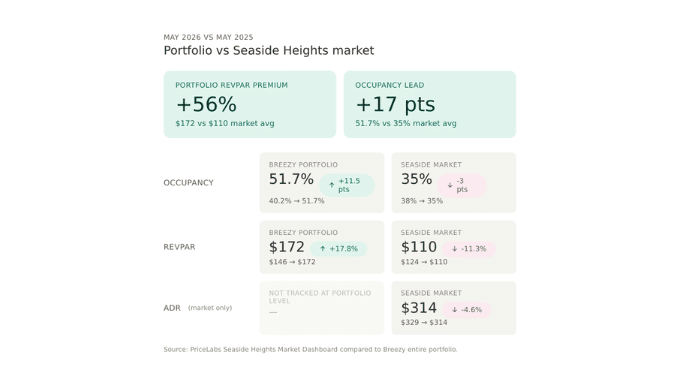
According to PriceLabs market data for Seaside Heights, May 2026 compared to May 2025 looked like this: occupancy fell from 38 percent to 35 percent, a loss of three percentage points. Revenue per available rental dropped from $124 to $110, a decline of roughly 11 percent. Average daily rates slipped from $329 to $314. Across the board, the market contracted.
This is consistent with what is happening in short-term rental markets across the country. Supply has expanded faster than demand in many coastal leisure markets, and the result is more competition for every booking. The Jersey Shore is not uniquely affected. It is part of a wider supply-driven shift that is reshaping how properties need to be managed and marketed to perform.
That context matters, because it makes what happened inside our portfolio all the more meaningful.
The Breezy Beach Stays Numbers in May 2026
Here is where things get interesting. While the market was declining, our portfolio was growing.
In May 2026, Breezy Beach Stays hit 51.7 percent occupancy across our entire portfolio. The Seaside Heights market average for the same period was 35 percent. That is a 17-point gap in our favor, in a month when the market as a whole was losing ground.
Our RevPAR – revenue per available rental, which is the metric that most accurately reflects how a rental business is performing because it accounts for both price and vacancy – came in at $171.56. The market average was $110. That is a 56 percent premium over the rest of the market, in the same town, in the same month, against the same economic headwinds that everyone else was facing.
Year over year, the gap is just as clear. Our occupancy is up 11.5 percentage points. Our RevPAR is up nearly 18 percent. The market, in that same window, moved in the opposite direction on every metric.
Why This Is Happening: The Work Behind the Numbers
Results like this do not come from luck or from a favorable location. They come from decisions made months in advance, compounded across dozens of listings, across every part of the guest and owner experience. Here is what is actually driving the gap.
Pricing Discipline When Others Are Discounting
The instinct when bookings slow is to lower prices. Most operators in our market have already done exactly that, and many have also started accepting shorter minimum stays, breaking full vacation weeks into single nights and fragmented shoulder weekends just to fill gaps. On the surface this looks productive. In practice, it trains the algorithm to deprioritize those listings and trains guests to wait for last-minute deals.
We have held the line on rates and, where possible, maintained seven-night minimums longer into the season than most of our competitors. As the supply of intact summer weeks shrinks because others are fragmenting their calendars, the demand for what we offer goes up. It is counterintuitive, but the data confirms it.
A Channel Strategy Built Around Search Visibility
Distribution matters in short-term rentals. Where your property appears, how it ranks, and how the platform’s algorithm scores it relative to competitors determines how many potential guests ever see it in the first place.
We were invited to participate in a pilot program through Airbnb called Optimize. Properties enrolled in the pilot are listed exclusively on Airbnb and direct for the summer season. In exchange, Airbnb provides a reduced commission and a confirmed boost in search rankings. A confirmed ranking boost from Airbnb’s platform is genuinely rare. Most operators never receive any direct signal from the platform about how their listings rank. We ran it on a subset of our lagging properties first to validate the lift before rolling it out more broadly, and the results confirmed what we expected.
More impressions mean more bookings at stable rates, which is exactly what the May numbers reflect.
Amenity Optimization Across the Entire Portfolio
Earlier this season we added a crib rental option across every listing in our portfolio. It is a small thing operationally. It costs us very little. But it has already been the deciding factor for families choosing our properties over comparable alternatives in the area. Guests have told us so directly in messages and in reviews.
The broader point is not the crib. The broader point is that we are running this kind of optimization across more than fifty listings simultaneously, and we are doing it systematically rather than reactively. Every listing in our portfolio benefits when we find something that works, because we apply it everywhere at once.
Communication That Guests Actually Notice
Guest experience drives reviews. Reviews drive search ranking. Search ranking drives bookings. The chain is direct and well established, and the weakest link in that chain for most vacation rental operators is communication.
Our team operates a monitored line from 6:00 AM to 11:30 PM with a dedicated 24/7 emergency line overnight. Owners can reach us directly. Guests can reach us directly. When something goes wrong at one of our properties, the right person knows about it within minutes. That responsiveness shows up in guest reviews, and those reviews show up in our booking performance month over month.
It is not glamorous work. But it is the kind of work that decides whether a property builds a track record of five-star stays or a slow accumulation of complaints that algorithmic ranking eventually punishes.
Listing Quality as a Permanent Competitive Advantage
Professional photography, accurate and compelling descriptions, search-optimized titles, and correctly categorized amenities are table stakes for any serious vacation rental operation. What separates good listing management from great listing management is the ongoing discipline to update, test, and improve these elements continuously rather than setting them once and moving on.
We review listing performance data regularly and make adjustments based on what the data tells us. That kind of continuous improvement compounds over a full season, and it compounds even faster in a down market where the gap between well-managed and poorly-managed listings grows wider.
What a Down Market Actually Means for Property Owners
A softening market is not a death sentence for your property’s income. But it is a filter. It separates properties that are well-positioned, well-managed, and well-presented from properties that are running on autopilot and hoping demand will bail them out.
In a strong market, average management produces average results. In a down market, average management produces well-below-average results, because the guests who are still booking have more options and less urgency, so they have time to be selective. They choose properties with better photos, better reviews, better amenities, and faster responses. The properties that invest in those things capture a disproportionate share of whatever demand remains.
Our May numbers are a direct illustration of this. The market shrank. Our portfolio grew. The difference was not luck, and it was not location. It was the work.

What This Means for Renters Booking a Jersey Shore Vacation
If you are a guest looking to book a beach rental along the Jersey Shore this summer, the market conditions above are actually good news for you in some ways. There are more available properties than in recent peak years, and in many cases prices are more competitive than they were twelve or eighteen months ago.
What this environment also means is that quality varies more than it did when demand was tight and guests were willing to accept mediocre experiences just to get a booking. Right now, you can afford to be selective.
When you book through Breezy Beach Stays, you are booking through a management company with a documented track record of outperforming the market, a team that is reachable from early morning to late night, and a portfolio of properties managed with the same standards we hold ourselves accountable to in the data above.

The Summer Season Is Still Ahead
May is a shoulder month. The summer peak runs June through August, and July Fourth through Labor Day represents the majority of annual rental income for most properties on the Jersey Shore. The strategies driving our May performance are the same ones we have been building and refining for that peak window.
The booking windows for peak summer inventory are narrower than they have been in recent years, which means decisions made now about pricing, listing quality, and channel strategy will determine whether properties reach their potential or leave significant income on the table.
We are already positioned for the peak. Our calendars are moving, our pilot properties are ranking above the market, and our pricing holds because our listings earn the rate we charge.
If Your Property Is Not Pulling Its Weight This Summer
If you own a vacation rental on the Jersey Shore and your booking pace does not look anything like the numbers above, it is worth asking why. The market conditions affect everyone equally. How any given property performs within those conditions comes down entirely to how it is managed.
Breezy Beach Stays manages vacation rental properties across the Jersey Shore with a focus on owner returns, guest experience, and the kind of operational discipline that shows up in data like what you read above. If you are a property owner who wants to understand what full-service professional management could realistically do for your revenue, we are happy to have that conversation.
There is still time to make this season count.
Share this post
Our Blog
Lastest blog posts
Fresh stories, tips, and behind-the-scenes moments—see what’s new on the blog.

October 16, 2026
Belmar St. Patrick’s Day Parade 2027: The Complete Guide

October 7, 2026
Visiting Island Beach State Park: A Guide From Seaside Park